
Higher Dimensional Polytopes

A guest post by Bobby Holmquist:

It is common in sci-fi literature to hear about higher special dimensions. In Star Trek and Star Wars, one is able to access faster-than-light travel by accessing warp speed or hyperspace, respectively. In both of these cases, space time is being bent or “warped” into the fourth dimension which allows for faster-than-light travel without actually breaking the speed of light. By adding a fourth special dimension to space-time, we are able to then “fold” space and instantaneously jump from one point to the next. Think about space-time like a piece of paper where you want to get from one point to the other. In normal space-time, the obvious answer is a straight line but by adding a third dimension of maneuverability, we are able to fold the paper and put the two points right next to each other and so are able to move from A to B instantaneously. This is how faster-than-light travel would work; we would bend space-time into the fourth dimension putting the points right next to each other.
Continue reading

Posted in Math | Tagged , | 1 Comment

OKCupid: The Math Behind Online Dating

Guest Author: Michalina Malysz

“Like you use sentences to tell a person a story; you use algorithms to tell a story to a computer” (Rudder 2013).

In today’s day and age, we have the world at our fingertips. The internet has made many things easier, including dating, allowing us to interact and connect with a plethora of new people–even those that were deemed unreachable just fifteen minutes beforehand.

Inside OKCupid: The math behind online dating talks about the math formula that is used to match people with others on the website OKCupid, the number one website behind online dating. Continue reading

Posted in Math in Pop Culture, Statistics, Technology & Math | Tagged , , | 3 Comments

Cost Functions in Ergonomics

This is a guest post by Sarah Dantino

Cost functions are linear functions describing a relationship between an initiator and its results. They are often used in business and accounting to predict and minimize future costs.  A worked-out example of constructing and minimizing an average cost function is in the YouTube video below by James Sousa.

I was interested in looking into how these cost functions are used in the analytical approach to ergonomics, which is an applied science to configure the work space so that it is both safe and functional. In this mathematical approach, Continue reading

Posted in Math, Mathematics in Society, Technology & Math, Uncategorized | Comments Off on Cost Functions in Ergonomics

Daily Quizzes: the Good, the Bad, and the Ugly—Part 1

This past semester, I decided to do something crazy—I gave my students a quiz (nearly) every day of class. You can imagine that my students weren’t nearly as excited as I was about this plan. In case you’re looking for a way to shake things up in your classroom, I want to share the good, the bad, and the ugly about my daily quiz system over my next two posts. Continue reading

Posted in Math Education, Teaching | Tagged , , | 1 Comment

Computers in Math Education

A guest post by Kyle Cluver:

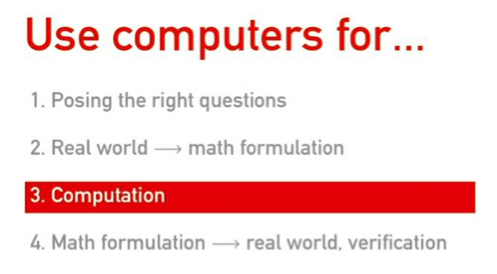
In Conrad Wolfram’s video, Teaching kids real math with computers, he discusses the interesting topic of mathematics in education versus real world mathematics. He argues that math education is all about calculating and that this “chore” can be done effortlessly with computers. He wants us to stop teaching calculating and start teaching math. Math in the real world is done by virtually everyone that is solving a problem or looking for the answer to some question. In school, math consists of lower level questions that require a lot of by-hand calculations. Problems seem simple and trivial compared to more challenging and rigorous problems in the real world. His answer to this problem is to have students use computers more for the computation aspect and to focus on posing the right questions, translating those questions into math problems, and verifying those results to their real world applications. His model for what math is and what it should be within our education system looks like this:

Cluver1Cluver2 Continue reading

Posted in Math Education, Mathematics in Society, Technology & Math | Tagged , | 3 Comments