Summer Reading List

My Summer Reading List


Having an industry job, I will not have any real change in my routine as summer hits. But I still think of summer as the season of reading for pleasure. So what are some new books out there that I’m thinking of reading, and where on the web can you find some excellent reviews of them?


1)   Love and Math by Edward Frenkel

  • NY Times review by Leonard Mlodinow

2)   How Not to Be Wrong by Jordan Ellenberg—wasn’t on my list until today after having read the following two reviews:

3)   The Best Writing in Mathematics edited by Mircea Pitici includes an article by my academic sister, Kelly Delp, on Topology and Fashion — that’s reason enough for me to buy the book J.  This title has been a yearly publication of Princeton University Press since 2010.

4)   50 Visions of Mathematics

I’m drawn to any book that focuses on the visual beauty of mathematics.

5)   Beautiful Geometry by Eli Maor, Eugen Jost

Again, pretty pictures!!! This is coauthored by an artist and a mathematician.

6)   Doing Data Science by Cathy O’Neil and Rachel Schutt

  • Revolution DataConsidering my current profession and the fact that blogger and Data Scientist Cathy O’Neil is one of the authors, it’s no wonder that this book is currently laying in my house…

7)   Our Mathematical Universe Max Tegmark


There are certainly no guarantees that I will get around to reading all of these—but in my experience, the first step to reaching a goal is setting it J. What’s on your summer reading list?

Posted in Applied Math, Mathematics and the Arts, people in math, Recreational Mathematics, Theoretical Mathematics | Tagged , | 1 Comment

Fermi Estimation with Liquid Mercury Splash Fights

The semester is over (sorry, quarter system folks, but you can get your revenge in August and September), and you just want to put your feet up and surf the Internet. Of course, there are lots of ways you might accidentally learn something while you do that. One of them is reading the xkcd “what if?” blog by Randall Munroe. Of course, xkcd is a favorite comic for a lot of math nerd types. “What if?” takes the more data-driven side of the xkcd comic and runs with it, figuring out answers, or at least reasonable guesses, to bizarre questions Munroe’s readers ask.

My favorite “what if?” so far is about extreme boating. “What would it be like to navigate a rowboat through a lake of mercury? What about bromine? Liquid gallium? Liquid tungsten? Liquid nitrogen? Liquid helium?” I learned that liquid mercury may be the least dangerous of all the options (but still, you should not get into a splash fight on a liquid mercury lake), that aluminum absorbs gallium (to the detriment of the structural integrity of any aluminum boats on gallium lakes), and that tungsten has such a high melting point that it’s hard to study in liquid form because it would melt any container we put it in. For some reason, I find that hilarious.

Everybody jumping on Rhode Island. Image: Randall Munroe.

Everybody jumping on Rhode Island. Image: Randall Munroe.

Or another gem: what happens if everyone on earth stands in Rhode Island and jumps at exactly the same time? Munroe does not stop with the physics, he goes on to the aftermath, the nightmarish logistics of having 7 billion people together in Rhode Island.

“Any two people who meet are unlikely to have a language in common, and almost nobody knows the area. The state becomes a patchwork chaos of coalescing and collapsing social hierarchies. Violence is common. Everybody is hungry and thirsty. Grocery stores are emptied. Fresh water is hard to come by and there’s no efficient system for distributing it.
Within weeks, Rhode Island is a graveyard of billions.”

There’s how fast we could drain the ocean, whether soda cans would be effective for carbon sequestration, and exactly how many world economies Au Bon Pain would need to pay a $2,000,000,000,000,000,000,000,000,000,000,000,000 lawsuit it’s facing. (Answer: a lot.)

“What if?” is not exactly mathematical, although it does have a lot of numbers in it. But I see it as a great way to play with Fermi estimation problems, which often show up in physics and engineering. Munroe’s answers are more thoroughly researched than a “real” Fermi problem, but the big idea of making carefully chosen, well-thought-out simplifying assumptions is there. Along with a lot of interesting chemistry and physics trivia. I could see these problems as part of a general education math or physics class. Students could look at the questions, figure out their own strategies for solving them, and compare their solutions to Munroe’s.

Whether or not you want to use the posts deliberately to induce learning, they’re always entertaining. (They might even help you get a friend to like math!) If browsing through the blog archive is not enough for you, there’s a book coming in September.

Posted in Math Education, Recreational Mathematics | Tagged , , , , , , , , | Comments Off on Fermi Estimation with Liquid Mercury Splash Fights

Crowd-Funded Mathematics

What if your research was funded by 100 strangers who had read your research proposal online and clicked “donate”? You’d feel responsible to write about your research in a more widely accessible way. You might pledge to provide monthly updates to your patrons in lieu of sending them a physical object. Or maybe high-paying donors could receive a 3-D printed physical representation, a piece of software, or access to an application online. While mathematics may not be winning any popularity contests amidst the general populous, scientific research is still appreciated enough by the general public that researchers are currently using sites like https://experiment.com/. This site is particularly tailored to funding science research just as sites like Kickstarter and Indiegogo are tailored to help start-up businesses. I was first drawn to this idea when I noticed several mathematics education projects seeking funds through crowd funding:

  1. Gary Antonick at the New York Times Numberplay blog recently featured Primo, a mathematical game designed by Dan Finkel, who blogs at Math For Love. The game is based off of thinking of prime factors as corresponding to different colors, allowing even younger children to play the game and learn basic operations as well as logical strategies for controlling their two pawns.
  2. Similarly, the Moebius Noodles blog is hosting a crowdfunding campaign for Camp Logic, a book that introduces older children to logic via games and puzzles. You can preview the book for free, which is written by Mark Saul and Sian Zelbo from the Courant Institute’s Center for Mathematical Talent.

Seeing the success enjoyed by these campaigns so far made me think about how this could be a partial solution to the problems discussed by Cathy O’Neil at Mathbabe concerning the declining number of research projects funded by government funds. One example of a research project involving mathematics that seems to have engaged many individuals enough to garner their dollars is OpenWorm. This is a project that aims to create a digital worm from scratch by using scientists’ knowledge of the molecular structures within the worm. The idea would be that in the future, some research on an animal could be conducted by simply “downloading” the animal. By programming low-level interactions within the worm, the project organizers have seen the movements that one might expect arise “organically”. Of course all of this modeling requires a ton of mathematics. The model is open source so that anyone can view the code using GitHub.


Posted in Applied Math, Math Education, Theoretical Mathematics | 16 Comments

Discovering Proofs

Patrick Stevens is an undergraduate mathematics student at the University of Cambridge, and I’ve really been enjoying his blog recently. He’s been doing a series of posts about discovering proofs of standard real analysis theorems. He writes that the series is “mostly intended so that I start finding the results intuitive – having once found a proof myself, I hope to be able to reproduce it without too much effort in the exam.” When I teach analysis, one of my main goals is for students to start developing their mathematical intuition, to learn how to “follow their noses.”

Hector the dog is following his nose, perhaps sniffing out a proof of the Heine-Borel theorem. Image: SaudS, via Wikimedia Commons.

Hector the dog is following his nose, perhaps sniffing out a proof of the Heine-Borel theorem. Image: SaudS, via Wikimedia Commons.

It’s fun for me to watch Stevens follow his nose and figure out these proofs, especially because I’ve done most of them with my students recently. In addition to figuring out the proofs, Stevens also writes about figuring out statements of theorems themselves.

“A little while ago I set myself the exercise of stating and proving the Contraction Mapping Theorem. It turned out that I mis-stated it in three different aspects (“contraction”, “non-empty” and “complete”), but I was able to correct the statement because there were several points in the proof where it was very natural to do a certain thing (and where that thing turned out to rely on a correct statement of the theorem).”

I’m trying to figure out how to incorporate these posts into my analysis class the next time I teach it. My instinct is to make them recommended reading for my students, but I’m not sure the best way to make that an active learning moment for them, rather than just another time for them to watch someone else do math. Perhaps a writing assignment where they walk through the details like Stevens does would be better. Or I could suggest that they work along with Stevens and try to figure out what the next step will be. If they come up with different steps, it would be good for them to figure out how they are different and whether they are both valid ways to continue the proof.

In a post about making topology simpler, Stevens tackles the eternal confusion that the words “open” and “closed” create. I talked about that confusion on my other blog last September, and there is a pretty great video about it called Hitler Learns Topology. (I don’t usually like Hitler parody videos, but this one cracks me up.)

I’ve been reading Stevens’ blog for a while, and I would be remiss if I did not highlight my favorite of his posts so far, Slightly silly Sylow pseudo-sonnets. Yes, they are poems about the Sylow theorems. Here’s the first one:

“Suppose we have a finite group called G.
This group has size m times a power of p.
We choose m to have coprimality:
the power of p‘s the biggest it can be.
Then One: a subgroup of that size do we
assert exists. Two: conjugate are Sy-
low p-subgroups. And m‘s nought mod np
And np=1(modp); that’s Three.”

Posted in Math Education, Theoretical Mathematics | Tagged , , , | 3 Comments

Narrowing The Gender Gap

This 3-minute clip of Astrophysicist Neil DeGrasse Tyson is the kind of thing that might provide just the right bit of encouragement to someone struggling to express their passion for STEM. Neil DeGrasse Tyson Said What He Thinks About Race Now That He’s Made It, And Almost Nobody Noticed.

Many years ago a math professor told me that he thought more men than women had the “lone wolf” mentality necessary to succeed in academia.  After my lack of response, he added “I assume you don’t agree,” and proceeded to explain to me the idea that mathematics is not friendly to a more collaborative approach and that women are not well-suited to the publish-or-perish culture of academia.  The assertion that genetic differences between men and women might explain why there are fewer female academics in the sciences was famously brought up by Larry Summers many years ago, but continues to be a popular explanation for the gender gap.  In fact a recent post entitled “Neil deGrasse Tyson makes an excellent point but Larry Summers is still right” on Scientific American’s The Curious Wavefunction espouses more of this type of thinking.

One of the ideas that Chris Martin, author of the above post, proposes is that women have a wider variety of interests so that a woman who is good at math might also be good at writing.  And then she might choose a writing intensive career where as men are more one-track minded, and would be good either only in math or only in writing.  The man would therefore risk putting all of his effort towards honing that skill, sacrificing relationships and other aspects of his life to that end.  This theory is at first appealing, but I know that I greatly enjoy the flow (the sense of time being irrelevant) when I am deeply entrenched in a problem, and I am sometimes quite focused to the dismay of my husband or child.  So when I read Izabella Laba’s post at The Accidental Mathematician entitled G.H. Hardy and Mrs. Ellis , I really identified with the idea that she put forward.  Her response to the Greater Male Variability Theory is that women have been conditioned by society to be pretty good at a wide variety of things rather than being exceedingly good at any one.  She quotes a popular 19th century book of advice by a Mrs. Ellis in which women are cautioned against trying too hard at any one thing.  And then I tried imagining the reactions that might be garnered by a woman who went without shaving for weeks until her body hair grew long and scraggly, who refused to spend more than two hours a day with her child, who was so deeply lost in thought that she did not bother responding to colleagues verbal greetings and stared at the floor while she paced the halls….

While Mr. Martin’s explanation is based on evolutionary biology, Dr. Laba’s explanation is one based on culture and societal pressures.  While Martin claims that the socialization model no longer holds water, many commenters disagree with him.

They point to studies such as the ones highlighted by recent Huffingtion Post bloggers Women Aren’t Bad At Math, But New Study Suggests Both Genders Think They Are and Why is the Math Gender Gap so much worse in the US that in other Countries? In these posts, the writers discuss the gender gap in two different contexts: the job market and in education.  But in both cases, stereotypes get in the way.  A related phenomenon is Imposter Syndrome, which is discussed in Faking It: Women, Academia, and Impostor Syndrome.

Being an optimist, I am going to operate under that assumption that removing obstacles is not a waste of time.  Here is one great list of proposed changes for academia to consider: How to Level the Playing Field for Women in Science

A new NPR series on Women in STEM features an interview with Jo Boaler, a well-known mathematics educator who talks in particular about educating girls in math.

And here is a blog where you can read all about and post about the science your grandmother did: Grandma Got Stem!

Please share your opinions and other good blog posts that address mathematics and the gender gap.


Posted in Issues in Higher Education, people in math, women in math | Tagged , , , | 2 Comments

Climate Science Blogs to Follow for Earth Day

This blog has now made almost exactly one trip around the sun! We kicked things off last year on Earth Day with the mathematics of planet earth, and today I want to highlight some more posts about our planet.

A picture of Earth from low orbit. Image: By NASA/NOAA/GSFC/Suomi NPP/VIIRS/Norman Kuring (- Blue Marble 2012) [Public domain], via Wikimedia Commons

A picture of Earth from low orbit. Image: By NASA/NOAA/GSFC/Suomi NPP/VIIRS/Norman Kuring (- Blue Marble 2012) [Public domain], via Wikimedia Commons

On Azimuth, John Baez has been hosting a series of guests posts by Steve Easterbrook about the 2013 Intergovernmental Panel on Climate Change (IPCC) report. (Find them under the “climate” tag.) Easterbrook is a computer science professor at the University of Toronto who has been focusing his research efforts on problems related to climate change.

Easterbrook’s posts are about the report from the first working group, but this Google+ post suggests that Baez may have guest bloggers write about the reports from the other two working groups as well. It also has an interesting discussion about why he is hosting the series on his blog. The report is available online, along with a fairly accessible summary for policymakers, but the blog format can feel like less of a commitment for readers. (I am among those who read the blog posts but wouldn’t have sought out the report.)

I’m glad Baez has had this series not just because I now know a little bit about what’s in the IPCC report but also because it led me to Easterbrook’s blog Serendipity. In addition to posts about various aspects of climate science, he has some nice ones about academia, including how to write an abstract and what skills he thinks are essential for PhD students in computer science. This roundup of climate models that can be used in the classroom looks like a useful resource, and this post on initial value problems versus boundary value problems is a nice explanation of the difference between weather and climate.

A little bit of blog-surfing from Easterbrook’s blog led me to the PLOS blog All Models Are Wrong by Tamsin Edwards. Edwards is a climate scientist at the University of Bristol with a physics background. Some of her posts that I’ve enjoyed include “nine lessons and carols in communicating climate uncertainty,” a post about her research on Greenland’s waterslides, and why as a climate scientist she does not advocate particular policies.

Posted in Applied Math | Tagged , , , , , , , , | Comments Off on Climate Science Blogs to Follow for Earth Day

Bad Statistics: Ignore or Call Out?

Andrew Gelman has been wondering how much time he should spend criticizing crappy research, and so am I. He wrote the post after a discussion with Jeff Leek of Simply Statistics about replication and criticism. Harsh criticism of preliminary studies could discourage new research, which would definitely be a bad thing, and Leek notes that shaming people who do research that gets retracted is probably not going to help science be self-correcting.
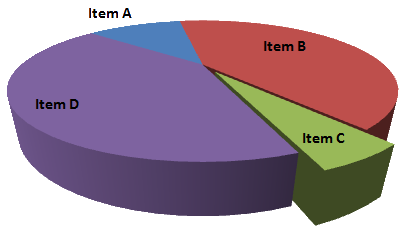
3-D pie charts are often misleading. Image: Smallman12q, via Wikimedia Commons.

In an earlier post on the topic, Gelman says that he is not against the publication of these early, possibly incorrect results. But if a bad study, especially about health, gets a lot of publicity, it could be harmful to people who read about it and take it seriously. In the later post, Gelman writes,

“A key decision point is what to do when we encounter bad research that gets publicity. Should we hype it up (the “Psychological Science” strategy), slam it (which is often what I do), ignore it (Jeff’s suggestion), or do further research to contextualize it (as Dan Kahan sometimes does)?”

More broadly, I’ve been wondering how much time should we spend criticizing bad science and math journalism or bad behavior in general. If misinformation is reported far and wide, it might be important to do some debunking, but in many cases, responding to bad things will just give the bad things more attention. (For example, I don’t think we should give Westboro more media coverage.)

Recently, there’s been a little kerfuffle about the fact that physicist Lawrence Krauss, among others, appears in a geocentric documentary made by a Holocaust denier. Krauss says that he doesn’t know how he got in the documentary and wants us to just ignore it. “Many people have suggested I litigate,” he writes. “But this approach seems to me to be completely wrong because it would elevate the profile of something that shouldn’t even rise to the level of popular discussion.” And in this case, I agree. The articles criticizing this documentary have given it tons of free publicity. Without them, it would have disappeared into the ether.

Right now I’m particularly fed up with news stories about how ignorant people are (as Cathy O’Neil writes, these are the stories about how many people think the sun goes around the earth), and I want to debunk them. After seeing a couple articles with a specific claim I found a little hard to believe, I got a hold of the poll data. And surprise, surprise: the articles make people out to be more ignorant than the poll seems to suggest (and the poll itself seems much less a representative sample of some society than a bunch of people who responded to an online poll that was only open for a few hours). Some misleading information about this poll is published in a few places, but it hasn’t gone viral. If I wrote about it, more people would see the original misleading information and might remember it instead of my correction. I would get some satisfaction from criticizing the other articles, but I don’t think it would help anything. Besides, I like to make people happy with math, and writing about something true and interesting is probably a better way to do it than taking something else down.

I really liked the end of Gelman’s post:

“A few months ago after I published an article criticizing some low-quality published research, I received the following email:

‘There are two kinds of people in science: bumblers and pointers. Bumblers are the people who get up every morning and make mistakes, trying to find truth but mainly tripping over their own feet, occasionally getting it right but typically getting it wrong. Pointers are the people who stand on the sidelines, point at them, and say “You bumbled, you bumbled.” These are our only choices in life.’

The sad thing is, this email came from a psychology professor! Pretty sad to think that he thought those were our two choices in life. I hope he doesn’t teach this to his students. I like to do both, indeed at the same time: When I do research (“bumble”), I aim criticism at myself, poking holes in everything I do (“pointing”). And when I criticize (“pointing”), I do so in the spirit of trying to find truth (“bumbling”).”

I’m going to take the easy way out and agree that we need balance. Personally, I don’t think I’m suited for doing a lot of pointing. Occasionally I write about something I think is bad and why, but mostly I’m going to keep writing about stuff I like and hope that my good stuff distracts from other crappy stuff. (As John D. Cook writes, quality over quantity. I found that post via another post of Gelman’s.) But there are other people who do a great job at criticizing the crappy stuff. This StatsChat post from Thomas Lumley about whether Generation Y spends a lot of money on fancy food cracked me up.

Of course, one reason I don’t do as much pointing is that I write more about math and less about statistics and how it’s used in other sciences. I think there’s more need and opportunity for pointing in those fields. When done well, I think pointing out bad statistical practice and the bad journalism it sometimes spawns might help journalists and readers approach scientific studies with the appropriate amount of skepticism and ask the right questions about them. A girl can dream.

Posted in Statistics | Tagged , , , , , , | 2 Comments

Mathemagical Thinking

So maybe you’ve seen the Flash Mind Reader.  If not, go ahead and try it!  I wouldn’t dream of depriving you (especially as this is year’s MAM theme is mathematics, magic, and mystery awareness).  What you are asked to do is to think of ANY two digit number, add the digits together, subtract that difference from the original number, and then look up your number in a table of symbols.  Then the computer will read your mind and produce the correct symbol.  So the mystery is – why does it work?  We know it’s a trick, and it can’t be that hard since the computer did it.  So it’s bound to bug you until you figure it out, and there are a number of people who post things like “Flash mind reader revealed!!” and then proceed to expound on the method used to do this trick.  They make tables, they do a lot of writing, all to express some simple algebra.

Certainly this is the kind of magic that much of the public associates with math – fancy tricks with numbers.  And it does bear a passing resemblance to another kind of magic with which many of us are familiar.  When you’re turning a problem (a mystery) around in your head over and over again because you just can’t let it go, using symmetry to simplify and transform the ideas, you sometimes feel in a tancelike state.  This kind of sentiment is echoed in Vi Hart’s most recent post about creating Art Code.  She writes “One thing led to another and soon I had a simple animation I called Lost Memories of Desert Sand, and couldn’t stop staring.”  One might say that “magic” allows our thoughts to fit together just so and create something beautiful.  The gasp that follows many math tricks is also the gasp that sometimes follows a good presentation of a proof.  There’s a sense that magic has just been performed – you were following each movement of the performer ever so closely when all of a sudden they finished the proof – why yes they did!  And it was so clever!  And it made sense, right?  Or did it?  Wait a minute, what about that part over there?  There’s a sense of skepticism, excitement, and awe that accompanies the practice of mathematics.

Physics.org had a great post on Magic and Symmetry in Mathematics that speaks to this type of “magic” in math. One of this year’s Sloan Research Fellows, Dr. Ivan Loseu says “Any scientific discovery involves some kind of magic,” That is, various pieces that may seem to be completely unrelated eventually start to fit together through the fruits of one’s labor. “Since pure math is pure, all this magic is much more clearly seen.”

Ready for a fun video from Tadashi Tokieda, whose work I learned about from a guest post at Scientific American about this year’s recent Gathering for Gardener?

Dr, Tokieda from University of Cambridge likes to play with “Toy Models” that demonstrate certain unexpected, and one might say “magical” properties.  Check it out https://www.youtube.com/watch?v=f07KzjnL2eE, and you will probably find yourself spinning little tubes around and saying “paf, paf, paf!”.

So go ahead and work your magic this weekend!

Posted in Mathematics and Computing, Mathematics and the Arts, people in math, Recreational Mathematics | Tagged , , , , , , , | 2 Comments

Awesome K-12 Math Teachers Exist! And they have blogs.

I sometimes get tired of hearing about how “teachers (meaning K-12 teachers) just don’t understand this or that, or won’t try doing something new,” or are deficient in some way or another.  We often advise teachers to let go of the “deficit model” and trade in for the “abundance model” when thinking about their students, so why not encourage society to do the same for teachers.  In a sea of people bemoaning the state of our education system, we should consider these dedicated individuals are resources to be celebrated.  Disclaimer: I haven’t had either of these teachers myself, but based on their blogs, I am guessing they are awesome.  There are many wonderful teaching blogs out there, but these are a few that have recently caught my eye.

Fawn Nguyen’s blog, Finding Ways to Nguyen Kids Over, is full of ideas that could be used in both college and K-12 classrooms.

fawn nguyen math talks
One students strategy for finding the equation that describes the pattern: ” I see the center column as (n+1). Then there are 4 identical groups around the center, each one is a Gauss addition. My equation is C = (n+1) + 4[(n2+n)/2].”

My favorite part of her website is her Visual Patterns catalog, which is a whole bank of visual patterns that help middle schoolers connect algebraic expressions and geometric patterns.  This was especially nice from my point of view because she includes her way of doing “math talks” with these visual patterns, a simple but effective way of letting the kids think individually, share their ideas, and get feedback from classmates.In addition to sharing the mathematics that her class works on, Ms. Nguyen writes post like “I can’t afford not to” addressing the concern that there isn’t enough time to devote to activities outside of the typical curriculum like she does.  She shares some of the reflection of her students as evidence that Math Talks and other less conventional activities that she does in class are effective.  My favorite quote from a kid was “I thought it was clever because towards the end it wasn’t the rule, it was your rule.”

mathmunchpyththeorem

From a Math Munch post on paper representations of proofs of the Pythagorean Theorem. This is taken from an 1847 manuscript by Oliver Bryne.

The teachers at Math Munch: Anna Weltman, Justin Lanier, and Paul Salomon, who all taught or teach at Saint Ann’s School in Brooklyn.

I’ve liked this blog for a while and mentioned it before.  Recently, it featured a game with which, I am a bit ashamed to say, I became somewhat obsessed..2048.  If you haven’t already played this game, maybe it’s best that you continue to avoid it.  But if you are like me, you have not only played many times, but you play to win as quickly as possible.

justinlanierknots

Justin’s preparations for his math circle workshop

It seems that Justin Lanier is currently working at the Princeton Learning Cooperative and has his own blog “I choose math” which features most recently his foray into Celtic knot drawings at a math circle.


mikesmathpage3dprint

From Mike’s blog: “For example, from those two sources, and lots of trial and error, we were able to print out a hollowed out cube that illustrates the “Prince Rupert Problem” – a cube is actually able to pass through a second cube of the same size”

We shouldn’t forget that our parents are also our teachers, as is so obviously the case for kids who are homeschooled.  Take for instance, Mike, curator of mikesmathpage.wordpress.com.

  • Mike has a day job, but also makes videos in which he explains math to his sons in front of what appears to be a room plastered entirely with whiteboard.  My favorite post is the one he made about Gauss and finding the expected value of the number of ways to write an integer as the sum of two squares.  I could easily see using this problem in a number theory, probability, or real analysis course!  He also had a great post about how his family was inspired by Laura Taalman’s 3D Printing Blog that was featured recently by my co-editor, Evelyn Lamb.

Lastly, I like this idea, that Pi Day is a great day to thank you favorite math teacher, from a writer and “radical homemaker” Alicia.  Here she describes her math teacher:

“Listening to him talk about math was like entering an alternate universe. This place was full of excitement, creativity + experimentation…nothing like the black and white worksheets I was used to. Instead of boring work like solving for X, we created 3D graphs, puzzling out shapes likes ice cream cones and clowns by using multivariable equations. Once everyone had calculated a perfect design, we printed them out and hung them in the hallway: a mathematical gallery sprang up to usher us to class.

Watching someone who passionately loves their subject matter talk about French literature, statistics or anthropology is enlightening. The material almost doesn’t matter when you can watch someone’s eyes light up and their every animated gesture convey their fascination. Pi Day, or 3/14, is the perfect day to nerd out and send a huge thanks to teachers who have changed our lives.”

Posted in K-12 Mathematics, Math Education, people in math, Theoretical Mathematics | Tagged , , , , , , , | 1 Comment

Geometry and the Imagination

If you like geometric group theory or amazing pictures (but especially geometric group theory), you might want to start reading Geometry and the Imagination, written by University of Chicago mathematician Danny Calegari. I’ve been following it for a while, but I got inspired to write about it here by a recent post on some new software he wrote, kleinian. Logically enough, it is a tool for visualizing Kleinian groups. And isn’t this visualization beautiful?

The universal cover of a genus 3 handlebody, visualized using the program kleinian. Image: Danny Calegari.

If I had to sum up the blog in a sentence, I’d say that Geometry and the Imagination contains expository posts about hyperbolic geometry and geometric group theory written for a mathematically sophisticated audience, with a few flights of fancy (like this post on solving the Rubik’s cube) thrown in. Like many research-oriented blogs, it delves into many of the technical details of theorems and proofs but with a lot more helpful “big picture” signposts than most research articles have. For me, at least, as a grad student and early-career researcher, seeing the forest for the trees has been the most difficult part of starting to do research, so I am a fan of blogs with signposts.

A few years ago, Calegari’s student Alden Walker wrote a series of posts containing notes from Calegari’s hyperbolic geometry course. (Calegari and Walker were both at Caltech at the time. Walker is now a postdoc at the University of Chicago.) As I mentioned in my last post, I find notes like this very helpful because even when I know a subject, I haven’t always thought deeply about what order to present it in, what examples to use, and so on.

One fun post is on Kenyon’s squarespirals:

“The other day by chance I happened to look at Richard Kenyon’s web page, and was struck by a very beautiful animated image there. The image is of a region tiled by colored squares, which are slowly rotating. As the squares rotate, they change size in such a way that the new (skewed, resized) squares still tile the same region. I thought it might be fun to try to guess how the image was constructed, and to produce my own version of his image.”

In the rest of the post, Calegari moves from square tilings of rectangles to square tilings of a torus to arrive at an image that is quite similar to Kenyon’s original. Aesthetically, I prefer this intermediate gif, of rotating squares that do not spiral, so I’m including it instead.

Squares that rotate but do not spiral. Image: Danny Calegari.

If heavier math is your thing, Calegari has a threepart series on Ian Agol’s proof of the virtual Haken conjecture and a post on his and Walker’s result that random groups contain surface subgroups.

But my favorite post is Random Turtles in the Hyperbolic Plane. With a title like that, how could it not be? In it, he riffs on his daughter’s Logo programming project. She programmed a turtle to take a random walk in the Euclidean plane, so he looks at what happens when turtles take random walks in the hyperbolic plane. Hyperbolic turtles display some very interesting behavior, with a “phase transition” from a beeline to the boundary to something that really “looks like” a random walk, depending on the how size of each step compares to the size of the turn the turtle makes each time. It’s a surprisingly rich line of inquiry!

The walk of a random turtle in the hyperbolic plane. Image: Danny Calegari.

The walk of a random turtle in the hyperbolic plane. Image: Danny Calegari.

Posted in Theoretical Mathematics | Tagged , , , , , , , , , | Comments Off on Geometry and the Imagination