Like a book club with math instead of books

I love reading and the idea of book clubs, and I have always wanted to be part of a really stimulating and fun book club, with bright, unpretentious people thinking hard about good stuff. I haven’t found the book club of my dreams yet, but I may have found the math-instead-of-book version: Philadelphia Area Math Teachers Circle (PAMTC). Math Teachers Circles are communities of teachers, professors, and education professionals who meet to work on interesting mathematics problems. The model is similar to that of Math Circles for students (see Adriana Salerno’s report about her math circle here). Someone presents a problem, and the participants work on it in groups, everybody has fun and learns new math. Since the participants are teachers, there is some discussion of how to connect the problem and ideas to the classroom, and it is possible to serve wine (all the more like a good book club!).
"Pancake sort operation". Licensed under CC0 via Commons - https://commons.wikimedia.org/wiki/File:Pancake_sort_operation.png#/media/File:Pancake_sort_operation.png

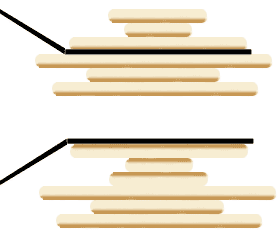
Pancake image by Derrick Coetzee, “Pancake sort operation”. Licensed under CC0 via Commons

It seems that the best problems for Teachers Circles are “low-threshold, high-ceiling” problems (in the words of the National Association of Math Circles, and someone I talked to during the meeting). These are problems that everyone can get started on and figure out some examples, but which generalize to any degree of difficulty, and often have extensions that are unsolved. At this month’s meeting of the PAMTC, my awesome Villanova colleague Katie Haymaker presented the pancake sorting problem. Basically, you are a waiter with n pancakes of different sizes stacked on a plate. You want to arrange them from largest to smallest, but your only tool is a spatula. The one move you are allowed is picking up some pancakes from the top of the stack and flipping them over. How many flips does it take to sort the stack? The number of moves it takes a maximally efficient algorithm to sort the worst stack of n pancakes is called the pancake number of n. These are known for small n but open for n=20 and beyond. Katie and I heard about the problem in a talk last year by Ivars Peterson, and she thought right away that it would be great for a Math Circle. She was totally right.

Katie had developed a couple of very simple slides about the problem and talked to the participants for just about 5 minutes, explaining the idea, then challenged everyone to find the pancake numbers of n=3 and n=4. The groups got right to work and spent an hour or so figuring out the first few cases, working mostly on their own with some facilitation from Katie and the other organizers. There was no lecture, no explanation of the right techniques—just questions to help organize and spark ideas. It was a room full of people talking to each other and doing math essentially for fun.

Katie Haymaker flips some pancakes at PAMTC.

Katie Haymaker discusses pancake flipping  at PAMTC.

After working, people shared their process, insights, and results. The teachers had developed some nice ideas about upper and lower bounds for the pancake numbers. Katie gave them a handout that she’d made explaining the problem and some more resources and directions. The meeting ended with one of the organizers, Josh Taton, leading a short activity on evaluating curricula.

Having spent a lot of time planning activities for my math classroom (and having them not always be as fun as I’d hoped), I was surprised by and excited about how well it all worked at PAMTC—kind of a dream of what math class could be like if everybody wanted to be there. Why did it work? First of all, I think this was just a good group, with some veterans scattered around the tables keeping things running smoothly. The organizers deserve a lot of credit for creating a good atmosphere, providing good food so that people could relax and do math at dinner time, and working with the presenter to make sure the problem was presented in an accessible yet exciting way. Katie chose a great problem and did the work of turning into an activity, by creating a handout and providing little disks to use as manipulatives (physical problem solving props).  The teachers mentioned that the manipulatives had been really helpful.

One very helpful additional way to make Teachers Circles work is to find a way for teachers to get professional development credit for attending. The other side of this is the importance of professionalizing Math Teachers Circles for professors–finding a way for professors to also get credit for their work with the Circles when applying for tenure and promotion. After talking to friends who have been involved with Math Circles and Teachers Circles, it seems that not every department values faculty members’ contributions to Circles. I would love to (and plan to) start a Math Circle someday, and I hope that it will be perceived as worthwhile by my department.  NAMC is actively working to raise the profile of Math Circles and to help make sure that contributions to Circles are professionally valued.  They also have a ton of resources on their website (including Circle in a Box) making it much less time consuming and so theoretically possible for a pre-tenure professor to run a circle.

However, when I was at the Math Teachers Circle last night, I wasn’t thinking about professional credit, or that it was 5 pm, after a long day of teaching and everything else. I forgot about my big shopping bag of quizzes and homework to grade later, and that I still needed to calculate and report midterm grades for my students, as well as figure out what I was going to teach the next day. I was just digging the math. It would take something pretty cool to get me and 25 others, who all worked with people all day, to spend two hours sitting in small chairs in a middle school classroom, talking to each other about pancake numbers. I guess I can report that Math Teachers Circles are actually that cool.

Posted in math circles, Uncategorized | Tagged , , , | Comments Off on Like a book club with math instead of books

Sonia Kovalevsky Day at Hood College

Yesterday was the last day of our fall break, and also Hood’s 10th annual Sonia Kovalevsky Day. I’m embarrassed to say that before my interview here I’d barely even heard of Sonia Kovalevsky, and definitely never heard of a day of celebration in her honor, but she’s hard to ignore here at Hood. At a time when women were not even allowed to audit courses, she became the first female math Ph.D. and the first woman appointed to a full professorship in Northern Europe. She published – sometimes anonymously – in mechanics, differential equations, and analysis, until her death of flu and pneumonia at the age of 41.

For twenty years, Sonia Kovalevsky Days (SK Days, for short) have been hosted at colleges and universities around the country to introduce young women to mathematics. Ours brings girls and their teachers from local high schools to campus for a day to learn about math, its applications, and related careers.

At 9am, our charges for the day began arriving. The temporary tattoos on the way into the auditorium were a big hit, both with the high school girls and our own student volunteers.

IMG_7133IMG_7138

After a quick icebreaker, the girls went to their first session of the day. Some students learned about economics by manufacturing and trading their own goods, another session created a predictive model of height versus femur length to help solve a mystery, one examined latin squares, and one looked at the spread of disease using statistics (and blue M&Ms).

IMG_7149

Blue M&M disease

IMG_7145

Widget manufacturing for a paper-good-based economy.


After a snack and another rotation through the workshop sessions, we had lunch and watched a great presentation by two Hood students on the life of Sonia Kovalevsky. The day closed with a career panel made of business and research analysts, an engineer, and an operations manager in the area, many of whom are Hood alums. The panel was moderated by Hood professor (and SK Day organizer extraordinaire) Dr. Jill Tysse.

IMG_7158 We had so much fun that nobody minded sacrificing a day of break to help. I’ve been involved in events for women in science before, both as a participant and a college volunteer, so it was fun to see this from yet another perspective. And I know how effective these days can be – I still remember going to Bemidji State University twenty years ago as a junior high student, where I spent the day with other girls building 3D computer models and browsing through the biology specimen archives. It was fascinating to see a slice of what life as a scientist could be like. But more importantly, when social pressure pushing us away from geeky pursuits was at its strongest, we met female role models in science for the first time.

If your school is interested in putting together a similar event, I strongly encourage you to do so. From what I understand, the Association for Women in Mathematics is not currently funding SK Days, but we get support for ours through the department, local schools, and a generous grant from PNC Bank through our foundation office. If you need ideas for activities, AWM maintains a list of past workshops to crib from. It is a lot of work to put together – as I’ll find out first-hand next year, when I’ll help take on some of the organizing – but it was well worth the effort.

Posted in women in math | Tagged , , , | Comments Off on Sonia Kovalevsky Day at Hood College

Strike One for the PI

Sara’s post last week about applying for grants hit me right in the middle of, of course, applying for a grant. I found Sara’s tips very useful and loved the advice from the Chronicle on how not to get a grant. I also enjoyed Adriana’s take on not getting grants, as well as the excellent comments.  This week I thought I’d add my own (really great) experience with not getting a grant.

There was a time when I thought I’d never apply for a grant to do math. I mean, I’m a number theorist. What do I need money for? Numbers? Paper? I thought that only professors at R1 institutions needed to apply for grants, to support PhD students or strengthen their tenure cases. How incredibly wrong I was. I feel lucky that I don’t need a lab or to buy any expensive machinery for my research, but I do need time to work, to stay connected through conferences, and to travel to work with my collaborators, all of which cost plenty of money. For this year I have start-up funds and a yearly allowance from my department, but I’m also applying for the second time for the AMS-NSA Young Investigator grant. Last year I thought it would be nice to apply so I plunged in and spent a few weeks working up a research proposal. I didn’t get it (strike one). However, I present:

Four reasons it was worth applying for the grant I didn’t get

1) Writing this grant forced me to let go of old plans.

I have always been interested in lots of varied problems and had picked up several different projects since the beginning of graduate school. In my earlier research statements, I had included all my projects in an attempt to demonstrate breadth and adaptability. However, I could tell that a proposal that included all of these would seem scattershot and poorly focused. The separate background sections alone would take up most of the length I was allowed. So I had to choose one area where I was most interested in going, at least for these first few years. I decided to focus on curves over the rational numbers and finite fields, topics where I had active and exciting projects, instead of some other topics where my work was older or my questions weren’t as well developed. It was hard to cut those topics loose in my mind, but also liberating, because after consciously laying them aside (for now!), I have more energy for the ones I have chosen.

2) Writing this grant made me ask better questions, and gave me ideas on how to start answering them.

My previous (mostly job application) research statements were focused on explaining the research I had already done, with a few questions for future study. When I wrote those other statements, my goal was to show that I was an accomplished researcher with plans to keep my research moving. The grant’s research proposal had a different goal—I was asking for money and concretely stating exactly what questions I would answer with that money. First I had to ask myself what problems were really interesting, then sell those problems as being worthwhile. Second, I had to show I could solve them. I wanted to showcase my accomplishments, but only to demonstrate that I had the background, skills, and good ideas to address my stated questions. It seemed important to show that I had convincing plans of how to take at least the first steps. Of course that meant I had to really think about these first steps, and I found that I had ideas I’d never bothered to organize before. I thought I didn’t know how to start, but that was because I hadn’t honestly thought about how to start. Now I have.

Also, in the process of solving a problem I tend to get tunnel vision and ignore all diverging paths. I want to know this one thing!!! Who cares what else I know? Who cares about anything else?!?   And then it’s on to the next thing. In writing this proposal, I found that looking back on the work that I have done and thinking from a little distance about where I would like to go revealed the landscape very differently. I can see how one project might relate to another, and how this approach might apply in this other situation. It made me really excited about my research, and gave me more ideas I probably wouldn’t have had if hadn’t taken this time to reflect and try to create a narrative.

3) I will never again underestimate the amount of time it takes to apply for a grant.

After applying once, I have now done everything wrong once. With all this excitement about my research proposal, I didn’t spend much time last year thinking ahead about any of the other parts of the grant application. I assumed that the major part of the proposal was the research plan, and didn’t even think about the other parts carefully until a few days before the deadline when I logged in and started submitting my application. If you’re a beginner at writing grants, as I was, let me save you some pain and tell you right now that there are many more parts to the application. There’s the short summary, the budget, the biographical details and time commitments, the indirect rates agreement from the University, and the approval of the research office at the University. And also several other things that I’ve forgotten at the moment. Of course, I’d read the website and skimmed over the list of requirements, but they all seemed minor compared to the research proposal. When it came time to submit, I was somehow totally surprised by the fact that I needed to be in contact with my own University’s research office to get their approval and deal with indirect costs. The short summary sounds like no big deal, but it needs to do a lot of what the research proposal does, but in ONE PAGE! Holy cow. That is hard. Each supporting document took approximately 2 to 10 times longer to prepare than I’d anticipated. I wrote panicked emails to my university’s research office—“Help, this grant is due tomorrow and I need your approval!” They very kindly stepped up to help me at the last minute.

This application didn't take as long as building La Sagrada Familia, but it did take most of my trip to Barcelona.

Did Gaudi apply for grants?  This application didn’t take as long as building La Sagrada Familia, but it did take most of my trip to Barcelona.

And let me also mention that the last minute was happening for me in Barcelona, where I had gone on my fall break. This was really exciting, my first ever non-mathematical trip overseas. I thought I would just finish up the details on the plane and then submit my application from the airport when I arrived. Then off to enjoy my vacation! Needless to say, that didn’t happen. I was completely preoccupied and stressed for the first 4 days of my trip—trying to find wifi in Barcelona cafes, figuring out what time in Spain I could expect to get a reply from someone in Philadelphia, and what time exactly was the cut off for application submission. In the end, my proposal had several embarrassing typos, because of time pressure and because I wasn’t able to print for a final proofread on paper. By the time I hit “submit” I was exhausted, and felt really awful for spending the trip glued to my laptop. This doesn’t sound like much of a positive about applying for the grant, but I would never have imagined it could take so much time and now I know. I will never make such a ludicrous plan again.

4) The reviews from my rejected grant may be the most valuable feedback I have ever gotten on my research.

When I received an email last summer letting me know that I didn’t get the grant, I was disappointed. The next email, with the reviewer’s responses, sat in my inbox unopened for a couple weeks. I was steeling myself for some tough reading. When I finally read the reviews I was shocked. The reviewers were unbelievably nice, generous people who gave me a lot of encouragement and very helpful feedback on my application. They took the time to read it carefully, make thoughtful comments on the content, and very kindly suggest ways to improve it. These were clearly people who knew the area well, and they offered additional references and pointed out applications that I had not emphasized.  This was perhaps the most extensive feedback I had received on any document since my thesis.  I have to say that some reviewers of my papers have also offered excellent feedback, but the grant reviewers discussed my whole research program–it was a little like having the opportunity to explain my research without nervousness to four experts in my field, then hearing their considered responses.  Far from being painful, reading my reviews was one of the most positive experiences I have had in sharing my research with the larger world. I was so excited that I wanted to revise and resubmit right then! Unfortunately the portal didn’t open again until September.


This year has been much better. I went in really knowing what was required and started my application online over a month before the deadline. I had time to let the University’s research office know what I was up to, and to ask my wonderful PhD advisor some questions about my research proposal. I have printed, proofread, and fixed scores of errors. I have revised the proposal to use the strange but appropriately formal language of “the PI” (and I do picture myself with a mustache every time I say that, in case you were wondering).  Of course, my application may not be funded this year either. But a) it might, b) there’s no way I will ever get funding without applying, so I’m not giving up, and c) if nothing else, round 2 will make the round 3 just that much better.

Please let me know in the comments if you have any great grant advice, or have made any of the grant mistakes that I did.  Good luck!

Posted in dealing with rejection, grant proposals | Tagged , | 1 Comment