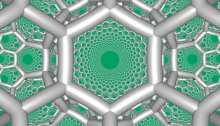
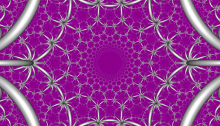
{6,3,6} Honeycomb - Roice Nelson

{6,3,6} Honeycomb

This is the {6,3,6} honeycomb, drawn by Roice Nelson. A 3-dimensional honeycomb is a way of filling 3d space with polyhedra or infinite sheets of polygons. Besides honeycombs in 3d Euclidean space, we can also have honeycombs in 3d hyperbolic space, a non-Euclidean geometry with constant negative curvature. The {6,3,6} honeycomb lives in hyperbolic space… and it’s special, because it’s self-dual!
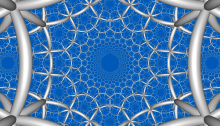
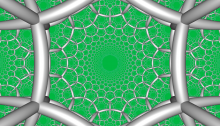
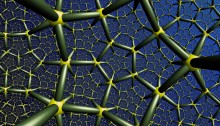
{6,3,5} Honeycomb - Roice Nelson

{6,3,5} Honeycomb

This is the {6,3,5} honeycomb, drawn by Roice Nelson. A 3-dimensional honeycomb is a way of filling 3d space with polyhedra or infinite sheets of polygons. Besides honeycombs in 3d Euclidean space, we can also have honeycombs in 3d hyperbolic space, a non-Euclidean geometry with constant negative curvature. The {6,3,5} honeycomb lives in hyperbolic space, and every vertex has 12 edges coming out, just as if you drew edges from the middle of an icosahedron to its corners.

{6,3,4} Honeycomb by Roice Nelson

{6,3,4} Honeycomb

This is the {6,3,4} honeycomb, drawn by Roice Nelson. A 3-dimensional honeycomb is a way of filling 3d space with polyhedra or infinite sheets of polygons. Besides honeycombs in 3d Euclidean space, we can also have honeycombs in 3d hyperbolic space, a non-Euclidean geometry with constant negative curvature. The {6,3,4} honeycomb lives in hyperbolic space, and each vertex has 6 edges coming out of it, just as if you drew edges from the middle of an octahedron to its corners.

{6,3,3} Honeycomb by Roice Nelson

{6,3,3} Honeycomb

This is the {6,3,3} honeycomb, drawn by Roice Nelson. A 3-dimensional honeycomb is a way of filling 3d space with polyhedra. It’s the 3-dimensional analogue of a tiling of the plane. Besides honeycombs in 3d Euclidean space, we can also have honeycombs in 3d hyperbolic space. The hexagonal tiling honeycomb lives in hyperbolic space, and each vertex has 4 edges coming out, just as if we drew edges from the middle of a tetrahedron to its 4 corners.

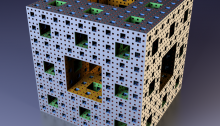
Cantor’s Cube

To make this shape, start with a cube. Chop it into 3×3×3 smaller cubes, and remove all of them except the 8 at the corners. Then do the same thing for each of these 8 smaller cubes, and so on, forever. The stuff that’s left is called ‘Cantor’s cube’.

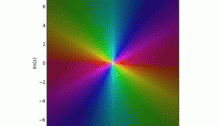
Weierstrass Elliptic Function (Zoomed Out) - David J. Chudzicki

Weierstrass Elliptic Function

The Weierstrass elliptic function is built up as a sum of terms, one for each point in a lattice in the complex plane. Each term has a pole at one lattice point. The picture here shows the very first term, namely $1/z^2$. That’s why it’s bright in the middle and the colors go twice around the color wheel as you go around. If you continue reading, you’ll see a movie made by David Chudzicki where further terms are added one at a time!

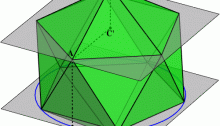
Icosahedron Illustrating Pentagon-Hexagon-Decagon Identity - Greg Egan

Pentagon-Hexagon-Decagon Identity

Suppose we inscribe a regular pentagon, a regular decagon, and a regular hexagon in circles of the same radius. If we denote the respective edge lengths of these polygons by $P$, $D$ and $H$, then these lengths obey $P^2=D^2+H^2$. So, the edges of a pentagon, decagon and hexagon of identical radii can fit together to form a right triangle! Recently Greg Egan gave a nice proof using the icosahedron.